
From professional networking to personal branding, memes and endless motivational posts, LinkedIn has changed considerably. But is it still a platform that businesses should invest in, or has it become another crowded social network competing for our attention?
Remember when LinkedIn was primarily about professional networking?
You logged in to connect with former colleagues, look for job opportunities, find people working in your industry, or perhaps reach out to someone whose work interested you. It was a fairly straightforward proposition: a professional network where business conversations happened.
Fast forward to today.
Your LinkedIn feed might tell you how someone spent their Sunday, what their five-year-old taught them about leadership, why their morning coffee changed their approach to business, or how a seemingly ordinary incident at an airport became a lesson in organisational management.
And then there are the memes, motivational quotes, personal confessions, controversial opinions and carefully constructed stories designed to generate thousands of reactions.
But does this change really amount to meaningful insight? According to the 2020 report on B2B Thought Leadership by Edelman Business Marketing and LinkedIn, H states that only 15% of decision-makers rated most of the thought leadership content they read as very good or excellent. Meanwhile, 57% rated it merely good, and another 28% considered it mediocre to very poor.
Somewhere along the way, LinkedIn became less about professional networking and more about performing professionalism.

This isn’t necessarily a bad thing. People do business with people, and understanding the person behind a professional profile has its advantages. But when every experience becomes a LinkedIn post and every individual is trying to establish themselves as a thought leader, the platform starts losing the very distinction that made it valuable.
Which raises an important question: Does LinkedIn still serve a meaningful purpose for businesses and professionals, or are we simply participating because everyone else is?
From finding opportunities to becoming the opportunity
LinkedIn was launched in 2003 with a fairly clear proposition: connect professionals, build networks and create opportunities.
Recruitment was a major part of its early appeal. Businesses could identify talent, professionals could showcase their experience, and people could build relationships beyond their immediate workplace.
Over time, the platform evolved. Publishing tools, company pages, groups, newsletters, creator features and advertising capabilities transformed it into a much broader content and marketing ecosystem.
Personal branding became increasingly important. Professionals realised that having a good CV was no longer enough; having visibility mattered too.
Then came the race for engagement.
The rise of AI-generated content has added another layer to this situation. According to research by Pangram Labs, 41% of long-form LinkedIn posts(over 250 words) analysed between April and June 2026 were identified as fully AI-generated. This raises an interesting question as to when a professional platform becomes increasingly filled with content that follows the same structure, expression and storytelling pattern?
The formula became familiar. Start with a dramatic opening line. Tell a personal story. Break it into short sentences. Add a lesson about leadership, resilience or business growth. Finish with a question to encourage comments.
Suddenly, everyone had a lesson to share, even when the underlying experience had very little relevance to their professional expertise.
The problem isn’t personal storytelling. The problem is when storytelling becomes an end in itself, rather than a way to communicate something useful.
Is LinkedIn actually losing its reach?
The race of maintaining visibility in LinkedIn’s saturated environment has become even more difficult amidst the changes to LinkedIn’s content distribution system.
An October 2026 analysis by iMark Infotech reported a 47% year-on-year decline in LinkedIn reach, citing multiple tracking sources. Although this figure should be treated as an industry estimate rather than an official LinkedIn-wide measurement, it highlights the growing difficulty businesses may face in maintaining organic visibility.

According to Metricool’s 2026 LinkedIn Study, average impressions per company-page post fell by approximately 23% year-on-year. Likes declined by 13%, comments by 17% and shares by 10%.
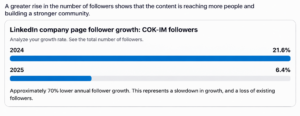
Socialinsider’s LinkedIn benchmarks also reveal a slowdown in follower growth. For company pages with 100,000 to one million followers, average annual follower growth dropped from 21.6% in 2024 to 6.4% in 2025.
Metricool’s research also found that only 7% of company pages grew sufficiently to move into a higher follower bracket.
These figures suggest that building an audience and maintaining organic visibility are becoming more challenging.
However, there is another side to this story. LinkedIn reports more than 1.4 billion members globally and 16% year-on-year growth in content views.
So, LinkedIn isn’t necessarily losing users or becoming irrelevant. There is more content, more competition and more difficulty in earning attention.
The distinction matters. A platform can continue growing while individual businesses find it increasingly difficult to reach their audiences.
And perhaps that’s precisely where marketers need to rethink their approach.
Does LinkedIn still have a purpose?
Absolutely. But perhaps not the purpose most businesses currently assign to it.
LinkedIn remains one of the few platforms where you can identify a company’s leadership team, understand its business priorities, research potential clients, find decision-makers and initiate a professional conversation without having to go through several intermediaries.
That is incredibly valuable, particularly in B2B marketing.
Think about it. If you’re trying to reach the marketing director of a large organisation, LinkedIn can help you identify the person, understand their professional background, see what they’re discussing and establish a connection.
You aren’t simply targeting a demographic. You’re identifying an actual individual within an actual business.
This is where LinkedIn’s real strength lies.
It is not necessarily the number of people who like your post or follow your company page. It is the quality of professional relationships you can build through the platform.
How businesses can make better use of LinkedIn
Rather than treating LinkedIn as another social media channel that needs daily posts, businesses should start looking at it as a professional networking, B2B marketing and lead generation platform. An effective LinkedIn marketing strategy goes beyond regular content publishing. It involves building brand credibility, identifying potential clients, connecting with industry decision-makers and creating meaningful business relationships. By using LinkedIn for business development, targeted outreach and professional engagement, companies can generate relevant opportunities and strengthen their digital presence.
- Stop chasing followers. Start identifying the right people.
A company with 2,000 relevant followers can have considerably more business value than one with 50,000 followers who have little interest in its services.
Identify the industries, companies, job roles and decision-makers that matter to your business. Build your network around them.
The objective should be relevance, not vanity metrics.
- Let people build credibility, not just company pages.
Company pages are important for establishing brand identity, sharing updates and providing a credible destination for potential clients.
However, businesses should not expect their company pages to do all the heavy lifting.
Encourage founders, senior management and subject matter experts to share genuine industry insights, opinions and experiences.
This doesn’t mean turning every employee into a content creator. It means giving people who understand the business a voice.
- Replace generic content with actual expertise.
The internet already has enough generic advice about leadership, productivity, marketing and entrepreneurship.
What people need is perspective.
Share actual business challenges, campaign learnings, industry observations, research, case studies and experiences that demonstrate an understanding of your field.

For example, instead of posting five tips for improving your digital marketing, discuss why a particular advertising campaign failed despite having a substantial budget, what the data revealed and what you changed.
Socialinsider’s 2025 LinkedIn benchmarks, based on an analysis of 2.45 million posts from 26,000 company pages, found that native document posts achieved an average engagement rate of 7%, compared with 4.5% for text posts with 3.25% for link posts. This suggests that businesses should pay attention not only to what they publish, but also to how they represent their expertise.
That is a conversation worth having.
- Use LinkedIn as a research and prospecting tool.
Before approaching a potential client, understand their business.
Look at their recent announcements, expansion plans, hiring patterns, leadership changes and business priorities.
A relevant message demonstrating that you understand their business is considerably more valuable than another generic sales pitch.
The platform should help you make your outreach more informed, not simply increase the number of messages you send.
- Measure business outcomes, not just engagement.
Likes, impressions, followers and comments are useful indicators, but they shouldn’t be the final measure of success.
Track how many relevant prospects you’re connecting with, how many conversations are starting, how many meetings are being generated and, eventually, how many opportunities convert into business.
If your LinkedIn strategy generates 20 meaningful conversations and three qualified opportunities, that could be more valuable than a post receiving 50,000 impressions.
Are LinkedIn Ads still worth the money?
This is where the conversation gets particularly interesting.
LinkedIn advertising has never been known as an inexpensive option. Its ability to target people based on professional attributes, job titles, seniority, company size and industry comes at a premium.
A June 2026 analysis by Search Engine Land, examining more than $700,000 in LinkedIn advertising spend across 63,000 clicks, reported an average CPC of $11.12 across the accounts studied.
For comparison, Google Ads averaged $5.45 across the same accounts. However, when comparing non-branded Google Search with LinkedIn prospecting, the difference narrowed considerably.
The point isn’t that LinkedIn advertising is necessarily overpriced. It is that businesses need to understand what they are paying for and what that investment is actually delivering.
For businesses running active direct-message outreach campaigns, this becomes an even more important consideration.
Let’s consider a typical B2B marketing setup.
You identify 500 potential decision-makers, connect with them, initiate conversations and follow up with relevant information about your services.
Now imagine running a paid LinkedIn advertising campaign targeting exactly the same audience through B2B audience targeting.
Are you reaching additional prospects? Are you building brand awareness before your sales outreach? Are you using LinkedIn retargeting ads to reconnect with website visitors and people who have already engaged with your content? Or are you simply paying to reach people your sales team is already approaching?
There is a difference between reinforcing a LinkedIn lead generation strategy and duplicating it.
LinkedIn Ads can work particularly well for:
- Building brand awareness among a clearly defined group of decision-makers before sales outreach.
- Using LinkedIn retargeting to reach website visitors and people who have engaged with your content.
- Promoting research, case studies, industry reports and other high-value resources through LinkedIn content advertising.
- Reaching additional members of a B2B buying committee beyond the immediate contact being approached.
- Supporting longer B2B sales cycles through repeated brand exposure and targeted advertising campaigns.
When aligned with a well-planned B2B digital marketing strategy, LinkedIn advertising can complement direct outreach, improve brand familiarity and help businesses reach relevant decision-makers at different stages of the buying journey.
However, if the primary objective is simply to generate a list of prospects and initiate conversations, a well-researched and personalised outreach strategy may deliver better value than an expensive campaign optimised purely for clicks or impressions.
Businesses should compare the cost per qualified conversation and cost per opportunity, not just the cost per click or lead.
The best approach isn’t necessarily choosing between paid advertising and direct outreach. It is understanding where each contributes to the sales process and ensuring that the two complement rather than duplicate each other.
Perhaps it’s time to bring LinkedIn back to its original purpose
There is nothing inherently wrong with sharing personal experiences, humour or opinions on LinkedIn. A professional network doesn’t need to be devoid of personality.
But there is a difference between being human and turning every aspect of your life into content.
Similarly, there is a difference between building a professional network and collecting followers who may never have a reason to do business with you.
For businesses, the opportunity is to move away from the obsession with visibility and focus on credibility, relevance and relationships.
Perhaps the real question isn’t whether LinkedIn is still worth using.
It is whether we are using it for the right reasons.
At DMC Digital, we believe the value of any marketing platform should ultimately be measured by the opportunities it creates, not simply the attention it generates.
And if LinkedIn can still help businesses find the right people, start meaningful conversations and build relationships that lead to business, it hasn’t lost its purpose.
We may simply need to rediscover ours.
References & Research Sources
The following industry reports, studies and research publications were referred to while preparing this article:
-
-
- Edelman Business Marketing & LinkedIn – 2020 B2B Thought Leadership Impact Study
- iMark Infotech – Clicks Down 42%, LinkedIn Reach Down 47%: What the Data Actually Shows
- Socialinsider – 2026 LinkedIn Benchmarks
- Brenton Way – LinkedIn Marketing Statistics
Reference: LinkedIn Marketing Stats
-