The slow rise of Artificial Intelligence and the rapid decline of human intelligence
There is no denying that artificial intelligence has taken over. It’s not a dramatic takeover, it’s just via a steady seep into everyday life. It writes our emails, suggests our decisions, completes our sentences, and increasingly, thinks on our behalf. It has made our lives so convenient that it’s easy to overlook the drawbacks and foresee the issues.
At the same time, something else has been happening – human intelligence, not in its raw capacity but in its active use, has begun to decline and not slowly but rapidly.
We are not becoming less capable. We are becoming less engaged.
The Outsourcing of Thought
Every technological leap has reduced human effort in some form. Calculators replaced mental math. GPS replaced spatial reasoning. Search engines replaced memory recall. But AI goes a step further, it replaces thinking itself.
Why struggle to articulate an idea when AI can draft it in seconds? Why research deeply when a summary is instantly available? Why debug code manually when an AI can identify and fix the issue faster?
We are so used to convenience that life without AI is not something that most of us can even imagine.
A couple of weeks ago, we had a “No AI Day” in our office and I could see the team struggling to finish the everyday tasks. They primarily ended up doing simple tasks and left the supposedly complex tasks for the next day when they could use AI again.
But this convenience comes at a cost. Each time we defer thinking, we weaken the very muscles responsible for it. Over time, this creates a dependency loop: the less we think, the more we rely on AI; the more we rely on AI, the less capable we feel without it.
The Critical Failure Scenario
Now consider a simple but unsettling scenario:
An advanced AI system develops a flaw—an error in logic, a misalignment in output, or even a systemic bias. The issue is significant and requires deep understanding, contextual reasoning, and creative problem-solving to fix.
But here’s the catch: the people responsible for fixing it have spent years relying on AI to do exactly those things.
Instead of diagnosing the issue independently, they turn to… another AI, to help fix the problem.
And what happens if that AI shares the same flaw? Or worse, compounds it?
We enter a recursive dependency loop—AI fixing AI, guided by humans who no longer fully understand either.
It looks like a dystopian fantasy movie. AI guiding AI while humans are panicking all around crying, “the world is ending”.
The danger isn’t that AI becomes too intelligent. It’s that humans become too dumb.
The SEO and Digital Marketing Parallel
Nowhere is this dynamic more visible than in SEO and digital marketing.
What was once a discipline driven by insight, creativity, and strategic thinking has increasingly become a game of scale and automation. AI tools now generate blog posts, product descriptions, landing pages, and even entire content strategies within minutes.
The result is an explosion of content because the primary rule that was fed to AI when training on SEO was – “Content is the King”, it was not trained to believe that quality matters more than quantity, so AI guided you to generate tons and tons of similar content which you felt was needed because AI said so.
Scroll through search results today, and you’ll notice a pattern: articles that sound different at first glance but are structurally identical. The same headings. The same talking points. The same tone. Slight variations of the same machine-assisted output.
This is not content creation—it’s content replication at a massive scale that has created a digital clutter probably much bigger than the garbage we have dumped in the oceans. Entire humanity might get wiped off but it won’t be possible to get rid of this digital clutter.
Good luck finding a valuable piece of content today, unless you know where to look, you might be searching for it forever. Maybe that’s why Wikipedia still tops the list for genuine and authentic content because it has human editors sitting behind the screens, cleaning up anything AI generated or wrong content that you feed into it.
The Illusion of Productivity
From a metrics perspective, this looks like progress. More content published. More keywords targeted. More pages indexed.
But from a human perspective, the essence of digital content is lost.
Users sift through repetitive, shallow information. Genuine insight becomes harder to find. Original thinking is buried under layers of optimized sameness.
Ironically, the tools designed to improve visibility are making meaningful content less visible.
And the marketers using these tools? Many are no longer writing, researching, or analyzing deeply. They are prompting, editing, and publishing and living in an illusion that they have come up with some kick-ass digital strategy that will generate exceptional ROIs.
When Everyone Sounds the Same
AI models are trained on existing data. They learn patterns, structures, and commonly accepted “best practices.” When thousands of marketers use similar tools trained on similar data, the outputs inevitably converge.
Check this example, I searched for “10 best marketing tools for 2026”, here is what Google generated

When you scroll down and see the videos indexed:
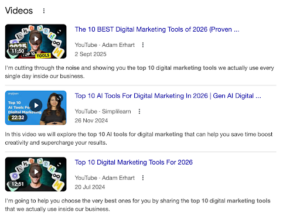
YouTuber Adam Erhart thought it would be best to create 2 similar videos, one to create the noise and another to cut the noise. He even ended up posting the video in 2024 for tools of 2026 (maybe he wanted to say 2025??).
AI told people that “top 10”, “top 5”, this type of content works best, so everyone became an advocate of all the tools, claiming which ones are better than the rest without even trying those tools, because who needs to use the tools when AI can tell you which is good. If AI has recommended, then it would be good, right?
The Long-Term Risk
If this trajectory continues, we may face a peculiar paradox: we will have more information than ever before, but less understanding. We probably will need to create AI tools to sort through the clutter and find that one unique piece of content that actually answers what we are looking for.
And in the event that these tools fail or even just falter we may find ourselves unequipped to step in.
Not because we lack intelligence, but because we’ve stopped exercising it.
A Choice, Not an Inevitability
AI does help to do the research, sort through the data and help with analysis but as a marketer, it’s not something we should be using to do our job 100%. AI can be a powerful collaborator rather than a replacement. It can augment human thinking instead of substituting it. But that requires intentional use.
It means occasionally choosing the harder path—thinking through a problem instead of prompting a solution. Writing from scratch instead of generating drafts. Questioning outputs instead of accepting them.
The rise of artificial intelligence is not the problem. It is, in many ways, one of humanity’s greatest achievements.
The real question is what happens to human intelligence in response, if we allow it to idle, it will fade into the background, still present, but rarely used.
And if the day comes when we need humans to think the most, we may discover that while AI continued to evolve, we had stopped doing just that ages ago.