“What do you want for snacks?” Screamed the host over the half-time. For a split second, the room was silent. No one looked up. We were already back to our screens, thumb-scrolling through Zomato. Pizza? Pasta? Burgers? Curry? Thai?
“Wait, I have a Swiggy coupon for KFC!” someone shouted, and suddenly, the “choice” was made, not by our appetites, but by whoever offered the best discount in the next sixty seconds.
Hosting was a lot different back in the day; it was an event, with optimum pizza toppings and edging on the ring of the door that the pizza would arrive in time.
The change was efficient and inevitable, but as we’ve perfected this frictionless journey, we have to ask: at what point does “convenience” stop being a service and become a reorganisation of our domestic lives?
The rise of takeout:
It is a matter of fact that our dependency on takeout has risen from the strategic depths of digitalisation, instant gratification and the convenience of the COVID-19 pandemic.
- In 1995, the first online restaurant delivery service launched. Called World Wide Waiter, the service aggregated more than 60 restaurants in the San Francisco Bay Area, and offered home or office delivery.
- In the 2000s, food delivery exploded in popularity. As smartphones became even more popular, food delivery apps came to dominate delivery services.
- Office workers could order food from their phones to the office without having to step away from their desks, and people who decided they’d rather not cook after work could have dinner solved with a few taps on their phones.
- The digital landscape has made the process of ordering frictionless, a necessity made essential by the pandemic, and the convenience of it all has made it a habit.
- During the height of the pandemic, the nature of delivery apps shifted from a marketing buzzword to a survival mechanism. For many, the “delivery partner” became the only physical link to the outside world.
- For the elderly, the immunocompromised, or those living in strict urban lockdowns, these platforms were essential. The act of “ordering in” was stripped of its luxury status and recast as a public health strategy.
 A team of food delivery executives in Amritsar on March 28. | Narinder Nanu/AFP
 A team of food delivery executives in Amritsar on March 28. | Narinder Nanu/AFP
- The pandemic also solidified the “Gig Economy” as a primary employer in the Indian urban landscape. As traditional sectors (hospitality, tourism, manufacturing) shuttered, the delivery sector absorbed hundreds of thousands of displaced workers. It provided immediate, low-barrier-to-entry income at a time when the traditional job market had evaporated.
- After the pandemic, the habit remains the same. Perhaps it has even increased our dependency on these apps.
Why is it that our dependency keeps increasing?
An article by The New York Times asked its audience the same:
“I am so burned out and tired, I would rather just throw my credit card at the problem and delay that unhappiness until the bill comes,”
“You can find almost anything available for on-demand delivery.”
“I was getting groceries delivered anyway,” “so if I am going to order groceries, I may as well order the whole meal.”
Outrage on social media justified:
“People aren’t going to get off their couch and drive out for a few extra rupees. Convenience, once adopted, is remarkably sticky.”
When food is always available, choice stops being deliberate and starts being habitual. Algorithms replace appetite.
Why?
Food delivery fills the gaps left by long commutes, dual-income households, academic pressure, and urban fatigue. Cooking isn’t about affordability but is about time, effort, and emotional bandwidth.
The Increasing Investment:
Increasing investments in food delivery apps are driven by a booming global market expected to reach $2.02 trillion by 2030, with a CAGR of 7.64% between 2025 and 2030.
How does this affect us as consumers and service providers ourselves?
 Firstly, with more capital flowing into these platforms, apps become faster, more efficient, and more personalised; this is what pushes us towards consumerism. We are encouraged to order more frequentlyrather than cook at home, reinforcing a “buy rather than make” mindset.
The enhanced marketing, discounts, and push notifications recommending things you’ve left in your cart lead to indulgence when it isn’t needed, normalising spontaneous spending.
These delivery apps are embedded in our daily routines, from late-night snacks to family dinners, making the occasional treat a default choice.
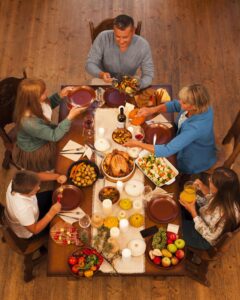
Yet, this shift carries a deeper cultural cost. Cooking has never been just about nourishment. The dining table isn’t merely a place to eat, but a space where stories are exchanged, traditions are practised, and relationships are sustained. Recipes carry memories of regions, generations, and moments shared. People eat alone, at different times, and frequently while distracted by screens, reducing opportunities for connection and cultural transmission.
Over time, this risks more than just a change in habit; it signals a loss of cultural continuity. Food becomes detached from its emotional and social roots. In prioritising convenience, consumerism does not just alter how we eat, but what eating means. The question, then, is not simply about resisting convenience, but about preserving choice, ensuring that we are not passively shaped by what is easiest or most visible, but consciously deciding when to engage, and when to return to the slower, shared rituals that give food its deeper significance.
But how does this affect service providers?
For service providers, the promise of digital reach offered precision and scale; now, it demands relentless investment. Marketing budgets increase to sustain visibility; however, returns tend to become uncertain as every brand competes within the same crowded ecosystem.
In this environment, promotions don’t persuade; they repeat. Discounts, push notifications, and limited-time offers arrive with such frequency that they blur into one continuous signal, producing ad fatigue and, eventually, indifference. Attention was once captured through the novelty of these campaigns, but is now filtered through habit. Consumers no longer engage; they scroll past, mute, or ignore.
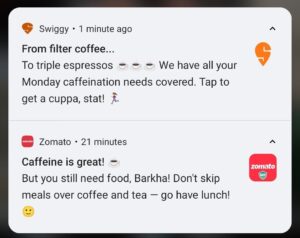
This is where the landscape begins to resemble what many describe as an “age of average.” When every platform speaks in the same tone, offers the same incentives, and occupies the same digital spaces, distinction collapses. Interfaces look alike, notifications sound alike, and value propositions converge into a single, indistinguishable stream. In response, consumers do not choose more carefully, but they choose less consciously, or disengage altogether.
For service providers, the cost is twofold: increasing financial strain alongside a loss of identity. Growth becomes dependent on louder signals rather than better ones, and loyalty gives way to momentary conversion. The challenge, then, is not simply to be seen, but to remain meaningfully different in a system that continuously pushes everything toward sameness.
The cost of living
As expenses rise, households increasingly rely on dual incomes, leaving less time and energy for domestic routines like cooking. 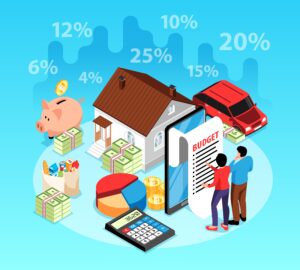 Parallely, the expansion of gig work has supported this ecosystem, offering flexible earning opportunities that sustain both the supply and demand sides of convenience.
While gig work provides immediacy and accessibility, the growing permanence raises questions about long-term stability and self-development. When work becomes fragmented into short-term, task-based roles, workers may find fewer opportunities to build skills or pursue sustained careers. The same system that enables convenience for consumers often relies on a workforce navigating uncertain wages, algorithmic control, and limited security.
Moreover, the nature of inflation within this ecosystem complicates perception. Grocery inflation is visible and linear when you see prices rise and adjust your behaviour accordingly. Delivery is becoming increasingly expensive, designed to increase without triggering resistance. This distinction matters. In a cost-of-living crisis, consumption is guided not only by actual affordability but by perceived cost. As a result, convenience becomes embedded not just in habit, but in the economic structure of everyday life, where time scarcity, labour shifts, and subtle pricing strategies converge to redefine how and why we choose to spend.
How long before consumers decide that cooking at home is cheaper after all?
As living costs rise and time increasingly becomes money, convenience feels justified, but repeated reliance gradually reveals its true expense. While grocery prices increase in visible, predictable ways, delivery costs are dispersed across fees and markups, making higher spending less immediately apparent but consistently present. What begins as an occasional substitute for cooking often becomes routine, shifting behaviour from conscious choice to default habit. Promotional offers and personalised nudges sustain engagement, but over time, the frequency of ordering can outweigh the perceived savings. In contrast, cooking at home, though time-intensive, offers greater control over cost, quantity, and consumption patterns. The comparison then is less about a single meal and more about how repeated decisions shape overall spending.
What began as a fruitful relationship with convenience now feels like a quiet negotiation with cost, habit, and control. Food delivery apps didn’t just enter our lives; they reorganised them, turning meals into moments of ease, while also creating patterns of spending we rarely question. Between hidden markups, layered fees, and algorithm-driven cravings, the true price of a meal is beyond monetary; it is behavioural. Yet, the alternative has always been within reach. The question is not whether we will abandon delivery altogether, but whether we will become conscious enough to choose when it deserves a place at our table. Because in the end, this isn’t just about how we eat, but about how much of that choice is still ours.
What this calls for is recalibration, a conscious redesign of the systems that shape how we encounter, interpret, and act on convenience.
At its core, this means rethinking how platforms engineer attention. Today, visibility is often synonymous with urgency: limited-time banners, countdown timers, and “only a few left” cues create a sense that action must be immediate. To change this approach would be to decouple the two, allowing discovery without pressure.
It also requires a shift in how recommendations function. Instead of being optimised solely for conversion, nudging users toward higher-value orders or more frequent purchases, recommendation systems could prioritise relevance, balance, and even restraint. This might look like surfacing smaller portion options alongside larger bundles, highlighting healthier alternatives without burying them, or recognising when not to push at all. In this model, recommendations guide rather than steer.
Equally important is the role of marketing cadence. Currently, the ecosystem thrives on continuous engagement: notifications, 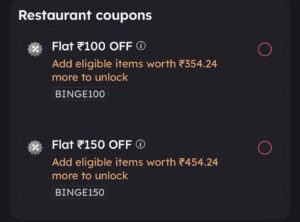 discounts, and reminders designed to keep the user in a loop of anticipation and response. Introducing intentional pauses would allow consumption to return to a more deliberate rhythm rather than a reactive one.
Convenience should remain what it was meant to be: an option, not a default, an ease, not an impulse. The change doesn’t diminish the value of delivery but in turn refines it. It creates space for users to engage on their own terms, where the system supports decision-making instead of overriding it.
Next match screening when someone asks again “What do you want for snacks?” The question lingers a second longer than before, not because options are scarce, but because awareness has quietly entered the conversation. Phones are still in our hands, apps still open, choices still endless. Pizza? Pasta? Burgers? Curry? Thai?
Only now, there’s a pause.
Someone looks up. “Should we just… make something?”
It’s not a rejection of convenience, not a dramatic shift. Just a moment of hesitation, of a choice reclaimed. The kitchen light flickers on. Packets rustle, a pan is taken out, and someone laughs at the lack of ingredients. It’s slower, less efficient, and slightly inconvenient.
But the room changes.